
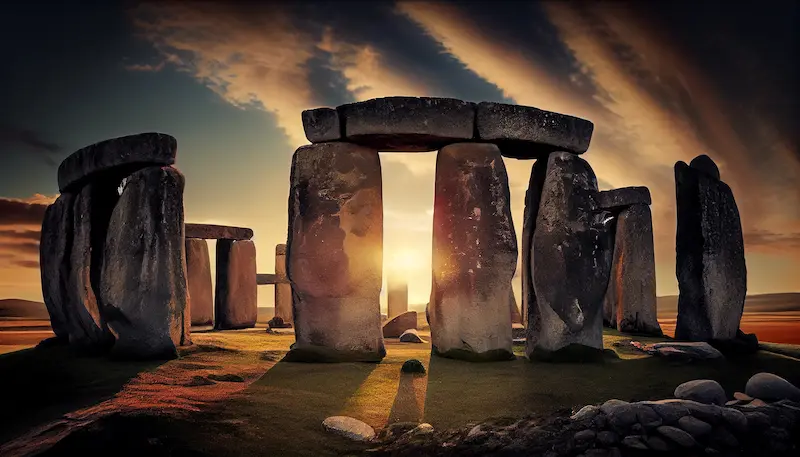
Stonehenge Mystery – History, Secrets & Ancient Legends
Stonehenge is one of the most important and familiar prehistoric monuments in the world. On Salisbury plain in the country of Wiltshire in England it is made up of very large standing stones in carefully planned position. It was built in at least three phases over thousands of years and may have first began around 3000 BC though the well known stone circle was not put up around 2500BC.
Today it is a monument which not only consists of massive standing stones, but raises and presents mysteries concerning its purpose, its build and who the people were who made and used it.
History of Stonehenge
Stonehenge was not built all at once. Stonehenge evolved over time through several stages in the early part of history and on a very grand scale.
The earliest monument on the site is dated to roughly 3000 BC and comprised a great circular ditch and banking around one hundred metres in diameter. This circle was packed with 56 pits, which we now know as the Aubrey Holes. These show evidence of being used for cremation for some centuries.
Around 2500 BC a great transformation was undertaken and large sarsen stones were brought to the site where they were placed in order to create the now-iconic circle and interior of Stonehenge. Additions and modifications continued into the Bronze Age over the ensuing centuries.
In effect, Stonehenge was not built on a single occasion; rather it is a site to the history of rebuilding, remodeling and ceremony.
The Stones of Stonehenge
Stonehenge used two different stones-sarsen and bluestones.
Huge sarsens stones, came from West Woods, nearer to the Marlborough downs-distance approximately 25km. Many of the sarsen stones weigh roughly 25 tonnes although some are even heavier.
Bluestones came from south west of Wales from the Preseli hills. They travelled more than 200km! It is amazing to try and figure out where, how and what the journey for the bluestones was.
It has to be one of the most extraordinary parts of Stonehenge.
How the ancient man transported the bluestones still fascinates archaeologists today.
How Was Stonehenge Built?
Maybe the biggest mystery is where people came to find machinery-free stone age equipment construction site-wide.
The people weren’t using any machines including tower cranes and any mechanical engineering machines like metal works or any modern machines and that evidence we found out is using primitive type equipments, as stone and hammer stone, animal horn made equipment, wooden built structure to carry the stone and ropes to pull and carry with the support of few hundred men who were responsible for food, tools and all the supporting resources, where some few men carried and lifted large up-right standing Sarsen stones pulled by some of the men by use of ropes by tying to the wooden structure around it and putting on the huge up right stand Sarsen stones. However, sarsen stones are joined by tongue and grove and some mortise and tenonjoints, which is common technique used woodworking.
Why Was Stonehenge Built?
The exact purpose of Stonehenge remains uncertain.
Archaeologists have proposed several theories. It may have been a ceremonial or religious monument, a place connected with ancestors and burial rituals, or a gathering place for communities.
The monument’s alignment with the Sun is especially significant. At the summer solstice, the sunrise aligns with the Heel Stone and the central monument. During the winter solstice, the setting Sun aligns with another part of the monument.
This suggests that the movement of the Sun and changing seasons were important to the people who built Stonehenge.
However, calling Stonehenge simply an “ancient calendar” would be too simplistic. Researchers believe it may have had several religious, ceremonial and social functions.
Stonehenge and the Solstice
he link between the summer and winter solstices is a striking part of Stonehenge.
The summer solstice is the longest day of the year in the Northern Hemisphere. At the time of summer sunrise the Sun aligns with the Heel stone at a point in the middle of Stonehenge.
The winter solstice is the shortest day. There are alignments associated with the winter sunset.
It is reasonable to assume that timing based on a predictable seasonal cycle would have had many uses to prehistoric farming communities who relied on the planting, growing and harvesting of crops for their existence. So the watching of the Sun may well have been both a matter of practical and spiritual significance.
Stonehenge as a Burial Site
The presence of cremated human remains during the archaeological excavation has links it to death and the funerary aspects: Stonehenge is regarded by English Heritage as one of the largest Neolithic cremation cemeteries know in Britain. These have been suggested as reinforcing its role to an ancestor and funerary element. The monument may have served as a place for the local communities to congregate to commemorate those who played significant roles and perform ceremonies which, among other things, connect the living community with their dead ancestors.
Stonehenge Was Part of a Larger Landscape
Another important fact is that Stonehenge did not stand alone.
The surrounding landscape contains numerous prehistoric monuments, including Woodhenge, Durrington Walls, the Stonehenge Avenue, burial mounds and the Cursus. Together, these sites form an extraordinary prehistoric landscape.
Durrington Walls, for example, was a huge prehistoric enclosure located near Stonehenge. The relationship between these different sites suggests that the wider landscape was carefully organised and used for ceremonies, gatherings and other activities.
The Mystery of the Builders
We know surprisingly little about the individual people who built Stonehenge.
They lived thousands of years before written history, so there are no contemporary written records explaining their beliefs or giving instructions about the monument.
Archaeology provides clues through human remains, tools, animal bones, settlements and the monument itself. From these discoveries, researchers have learned that the builders were part of prehistoric farming and pastoral communities.
The scale of Stonehenge demonstrates that these communities were capable of organising large numbers of people for major projects.
Myths and Legends
Stonehenge has inspired countless legends.
During the medieval period, stories connected the monument with Merlin, the legendary magician associated with King Arthur. Some medieval writers claimed that the stones had been brought from Ireland through supernatural means.
These stories are legends rather than archaeological explanations, but they demonstrate how mysterious Stonehenge has appeared to people for centuries.
The monument has also been associated with Druids, although modern archaeological evidence does not support the idea that the historical Druids built Stonehenge. Stonehenge is thousands of years older than the period in which the Druids are historically documented.
Stonehenge and Modern Archaeology
Although Stonehenge has been the subject of study for hundreds of years, modern archaeological research has revolutionized the understanding of the monument. Digs, scientific dating and analysis of the stones together with Geophysical surveys has produced results that add significantly to our picture of the monument and its setting. Areas of research such as the origins of the individual stones, the transportation method used to move the stones, and the different usage of the different parts of the monument are still being carried out. Therefore Stonehenge is not a fully resolved mystery.
UNESCO World Heritage Site
The World Heritage site, as recognized in the Stonehenge, Avebury and Associated Sites, celebrated the prehistoric monuments. UNESCO have stated it is ‘unique for its monuments and its sophisticated technology and architecture, and for its evidence of Neolithic and Bronze Age ritual traditions’. It draws attention to the “immense scale of stones, their transporting over the long distances and for the accurate stonework”.
The World Heritage site showcases how prehistoric people adapted this landscape for around 2000 years.
Why Is Stonehenge Still a Mystery?
What Stonehenge lacks is clear answers and we do not have a full history. However we have plenty of evidence and below are few clues of what we know from archaeological sources:
We have estimated the time frame of construction of main phases of Stonehenge; we know the areas of origin of several kinds of stone, and we know Stonehenge was involved in rituals, ceremonies and solstices alignments. Yet, in many aspects, Stonehenge still remains an enigma, as the following few points indicate:
Who were those who planned Stonehenge?
Why was it erected at this certain place?
How were all the stones moved?
Why were these stones repositioned over and over again?
What kind of ceremonies were conducted there?
What was their true meaning?
However, this very unknown is the most fascinating fact about Stonehenge which makes it perfect for the ‘Mysteries & Legends’ chapter.
Interesting Facts About Stonehenge
Stonehenge’s earliest major monument dates to around 3000 BC.
The famous stone circle was constructed around 2500 BC.
Some bluestones were transported from southwest Wales, more than 200 km away.
Many sarsen stones weigh around 25 tonnes.
The monument contains sophisticated stone joints normally associated with woodworking
Cremated human remains have been discovered at the site
The monument has strong alignments with the Sun and solstices
Stonehenge is part of a UNESCO World Heritage Site.
It forms part of a much larger prehistoric landscape containing many monuments
.Its exact purpose remains uncertain
Conclusion
However, Stonehenge is far more than just a ring of enormous stones. It provides a clue to the level of technical expertise, social, spiritual and astronomical knowledge attained by prehistoric peoples over four millennia ago.
Stonehenge was built and rebuilt over a huge period and with ties to burial practices, the Sun and its surrounding prehistoric landscape, we can be sure that it was a very important ceremonial centre.
Despite years of study Stonehenge still contains a great deal that has never been revealed and it is this blending of an astonishing engineering feat, the heavens and ancient mysterious ritual that remains its greatest enigma.