
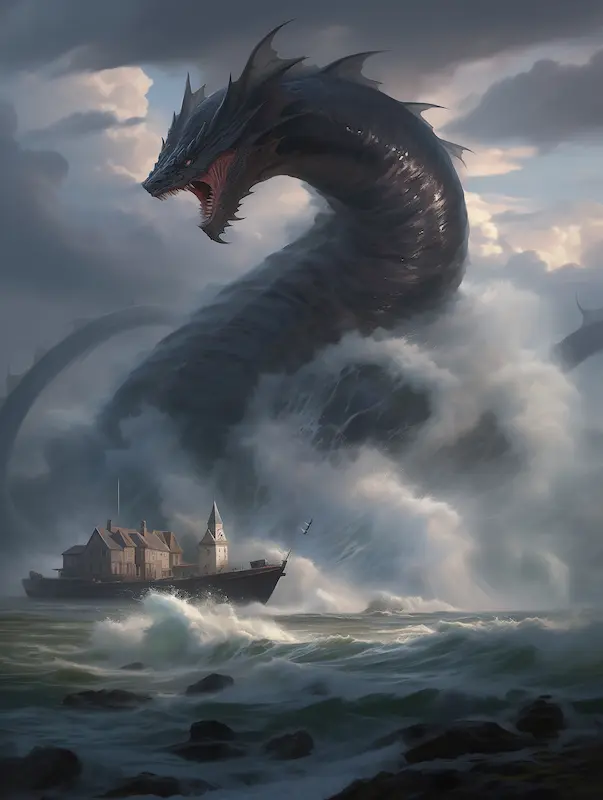
The Legend of Nessie
Tales of an odd creature inhabiting Loch Ness go back hundreds of years. One of the earliest widely known tales tells the story of Saint Columba, the Irish preacher, whom legend says faced off with a wicked water-dwelling monster in the 6th century, by the banks of the river Ness.
The Famous 1933 Sighting
The biggest event leading to the widespread recognition of an organism dwelling in Loch Ness occurred in 1933 when a married couple, Mr. and Mrs. George Spicer, claimed to have witnessed a bizarre creature crossing a road. They gave their accounts to the press which subsequently became news.
Hugh Gray also witnessed a bizarre creature swimming in the lake that same year; the creature shown in his photos have all come to be identified as “Nessie” or the Loch Ness Monster. In this process, Loch Ness turned into a focal point for crypt zoologists around the world.
The Famous “Surgeon’s Photograph”
The most iconic photograph for Nessie dated 1934 and entitled “The Surgeon’s Photograph” show what is thought to be a creature with a long neck rising from the lake. For many years this photograph has remained one of the most compelling evidence of Nessie existence, but it was later discovered to be fake hence diminishing its significance as an evidence.
What Is Nessie Supposed to Look Like?
Details differ but Nessie is generally thought to be an aquatic creature with:
- A long neck
- A small head
- A large body
- One or more humps
- Flippers
- Blackish or greyish skin
There has been one theory that suggested Nessie was an alive plesiosaur(a type of marine reptile that has long been extinct)
How Deep Is Loch Ness?
Loch Ness is a very large and deep freshwater lake. It is around 37 km long and over 200m deep.
Because the water in the lake is very dark and cold and very dark and has no visibility this has caused the problem.
There is a huge volume of water which makes it hard to search and is very difficult to search by using modern equipment.
Scientific Searches
Over the decades, researchers have used different technologies to search for evidence of Nessie.
These have included:
- Sonar equipment
- Underwater cameras
- Boats
- Aerial photography
- Environmental DNA (eDNA) research
- Large-scale lake surveys
One of the most important modern studies involved collecting water samples from Loch Ness and analysing them for traces of DNA.
Researchers found DNA from many organisms, but the results did not provide evidence of a giant unknown creature living in the lake.
Could Nessie Be a Real Animal?
Several natural explanations have been suggested for Nessie sightings.
Some researchers have proposed that people may have mistaken:
- Large fish
- Seals
- Floating logs
- Waves
- Boat wakes
- Birds
- Groups of animals
for a mysterious creature.
Another possibility is that unusual lighting and weather conditions can make ordinary objects appear much larger or stranger than they really are.
The Giant Eel Theory
An interesting thought is whether the sighting are related to large eels in some cases.
The European eel lives in waters off Scotland and they get to surprisingly large proportions. Many have been asked and thought that enormous eels could be the reason for some or all of the legend.
But there is no way to prove the theory completely.
Why Does the Mystery Continue?
So even after years of scientific investigation, there is no one definitive scientific fact confirming the reality of the Loch Ness monster.
There is no corpse, DNA, skeleton or definitive photograph proving that there is an enormous unknown monster living in the Loch.
People continue to see unusual shapes in the lake while one of the main reasons it continues to be so mysterious is that it is so deep, large and visually difficult to see in, from the banks at least.
The long, strange history, photographs, witness statements and vastness of the Scottish landscape combine together to make Nessie such an enduring riddle.
Loch Ness and Tourist Development
The myth has significantly contributed to the development of tourism surrounding the Loch.
Thousands of people now go out to the Scottish highlands to visit Loch Ness, discover nearby attractions, or investigate the Nessie phenomenon.
Prominently perched on one corner of the lake stands Urquhart Castle, a wonderfully located ruined medieval castle.
Interesting Facts
Name: Loch Ness Monster
Nickname: Nessie
Location: Loch Ness, Scottish Highlands, Scotland
Famous for: Monster sightings and legends
Modern legend: Became especially famous during the 1930s
Most famous photograph: The 1934 “Surgeon’s Photograph”
Scientific evidence: No verified evidence of a monster has been found
Popular theories: Giant eel, misidentified animals, waves, logs and other natural phenomena
Best known nearby landmark: Urquhart Castle
Conclusion
A story that enthrals one and all, the legend of the Loch Ness Monster continues to astound the world today. While scientific studies continue to fail to discover any evidence to suggest the presence of such a giant sea monster in the vast waters of Loch Ness, interest in the legend draws scientists, photographers and tourist as well as the ever faithful mystery fanatics alike. But whether the Nessie be a newly discovered creature, or perhaps a collection of misidentification or in reality a figment of imaginations, it looks as though Nessie’s mystery lives on for quite a while to come