
Nazca Lines Mystery – Ancient Geoglyphs of Peru
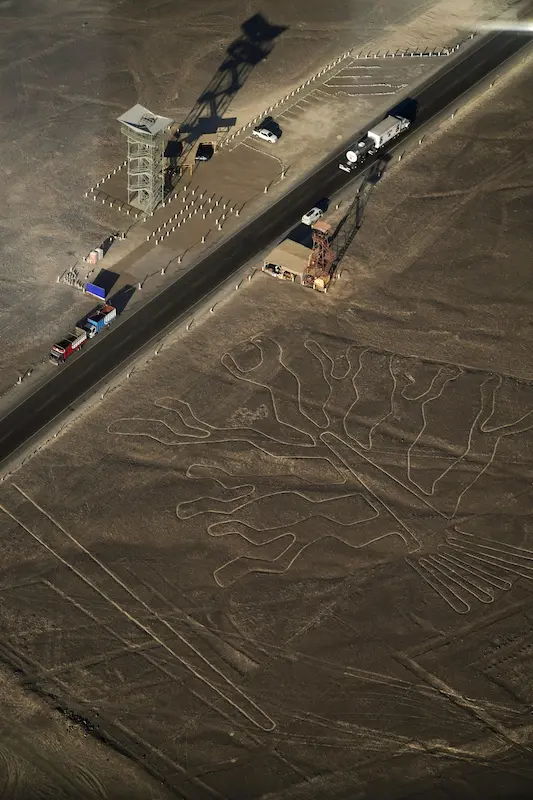
The Nazca Lines are vast ancient geoglyphs incised on the surface of the desert plain of southern Peru; composed of a network of straight lines, geometrical forms, and enormous figures in the shape of a bird, a monkey, a plant and others, a large proportion of which cannot be identified completely when seen from ground level, rendering them one of the most intriguing mysteries of the world’s archaeology.
Where Are the Nazca Lines?
Nazca Lines are found mostly in the desert plains between Nazca and Palpa in southern Peru. They are situated on a dry, flat plateau. The area is characterized by sparse rainfall and arid conditions which allowed the geoglyphs to survive for almost 2000 years. Individual figures of the geoglyphs can measure several hundred meters and they are scattered across this vast desert plateau.
Who Created the Nazca Lines?
The drawings in the main were made by the Nazca culture, which thrived in the area between circa 200BC and 600AD. Although it seems that many other figures throughout the Nazca region pre-date figures within the culture-so that this form of desert art began before the Nazcan dominance. These massive figures were not produced by modern aircraft or surveying equipment and yet their figures are absolutely huge and incredibly accurate.
How Were the Nazca Lines Made?
The method is incredibly simple.
Dark surface stones that appear as if they have been scorched form the surface of the desert. Below them is the lighter colored soil.
To engrave the lines the old people removed the darker stones from the ground and in their place dug out the lighter color.
To lay out the geometrical lines ropes and stakes together with the use of basic measuring rules would work for laying out the straight line drawings.
The lines contrast strongly with the darker desert surface.
The Nazca Lines include many different types of designs.
Some of the most famous figures include:
- Hummingbird
- Monkey
- Spider
- Condor
- Dog
- Heron or other bird figures
- Tree
- Hands
- Various geometric shapes
There are also thousands of straight lines and trapezoidal areas extending across the landscape.
Some designs are relatively small, while others are enormous.
The Famous Hummingbird
The Hummingbird is one of the most famous Nazca geoglyphs.
The beak, wings and tail are easily distinguishable viewed from above. The length is around 90m.
Its exact meaning is unknown.
THE SPIDER
The Spider is one of the well-known Nazca figures as well. The drawing covers about 46 meters and is one of several other significant geoglyphs. There have been several theories about the purpose of this drawing which might include relationship to rain or to fertility and religion, but a consensus has not been reached.
The Monkey
Another geogylph that has become very famous is that of the monkey with its immense curly tail.
This is a clear illustration of how skilled the Nazca were to reproduce figures with such a recognizable image on so grand a scale.
The monkey is of special interest, due to the totally out of place proportions and the incredible size of it.
Why Were the Nazca Lines Created?
That’s the basic mystery here.
A number of suggestions have been put forward by archaeologists about what they might have been used for.
Religious and Ceremonial Purpose
Another hypothesis attributes the existence of the lines to religious festivals and rituals.
Evidence suggesting certain geoglyphs were related to ceremonial activities and pathways have been noted. Researchers hypothesize that the line was traveled by procession for rituals.
Water and Fertility
Water was very important in the arid Nazca environment.
It has been argued by some that the geoglyphs may have been linked to water, agriculture, fertility and beliefs.
However, not every geoglyph can be explained by such an interpretation.
Astronomical Theory
A further theory states that some lines would have served for observations and markers of events related to astronomy.
Some researchers have tried to link lines with stars, the sun and seasons.
But a general and overall use of Nazca Lines would not have been merely astronomical calendaring, which this theory tries to state:
Social and Cultural Meaning
The geoglyphs may also have enabled different communities to express and articulate their beliefs and identity.
Such a large scale undertaking would need to have involved many groups of people. Their role was perhaps to give a social dimension, as well as a religious one to this huge earth works.
How Could People Create Such Huge Drawings?
One of the major debates regarding the Nazca Lines is how ancient peoples could have produced them. The common assumption is that an aerial perspective was crucial. This may not have been the case
They did not necessarily need an aerial view.
Geometrical formulas implemented on the ground could have been enough.
Stakes and ropes might have been used to guide workers extending the lines across the sandy surface. Excavation has already indicated that this method is quite plausible for the construction of large geoglyphs. Despite their scale, there is nothing that the Nazca Lines would have required beyond the technological capabilities available to the ancients.
The Mystery of Their Visibility
What adds to the intrigue of the Nazca Lines is that many of the figures can barely be recognised from the ground while becoming readily apparent from above. Henceforth, various theories have arisen regarding their purpose. Simply because figures are most visible from an aerial perspective does not necessarily mean the creators sought to look at them from above. A religious/ceremonial purpose relating to creation and pedestrian traversal of the site does not necessarily demand visibility from the sky.
The Mystery of Their Visibility
The incredibly dry atmosphere of Nazca has been one of the major factors in preserving these figures throughout centuries of activity. Rainfall is negligible, and natural erosion minimal owing to vegetation absence. Their survival is not absolute however; as modern development, roads, climate changes and the ever expanding human population threatens the ancient sites, maintenance has become important. Peru has the responsibility to maintain them.
Discovery: The Modern Eye
Local people are aware of many figures within the Lines before archaeological researches were started on a larger scale. The sites grew international renown in the 20 th century particularly when the desert began to be looked at from the air. Maria Reiche: a German mathematician turned archaeologist championed the work of discovering and protecting them for many years.
The Nazca Lines and Conspiracy Theories
Their size coupled with their peculiar forms inevitably lent themselves to various speculative theories. Among the more popular accounts are that the sites were created for extra terrestrial landing, that they assisted ancient peoples, et al. These theories, especially championed by Erich von Dniken, have no historical basis nor any scientific proof. Archaeologists relate these shapes to the civilizations in the region and their respective traditions.
The UNESCO Designation
The UNESCO World Heritage Site status bestowed on these figures in 1994 underlines the recognition of their amazing scale, cultural value and remarkable state of preservation. They represent “a great masterpiece of human civilization” according to UNESCO.
Extra information about the Nazca Lines
Located in southern Peru, they can range to up to hundreds of feet in length, dating as far back as 200 BC to AD 600. The famous shapes include a hummingbird, spider, monkey and others. The images were formed when soil or stones were removed, or dark stones rearranged in order to show the contrast with the lighter soil.
Climate is a key component of its preservation; it is believed by scholars that Maria Reiche contributed greatly to protecting this archeological heritage.
Exactly what their purpose was is still unknown and, of course, no alien intervention can be proven.