
Gingee Fort-Tamil Nadu’s Magnificently Forgotten Fortress
INTRODUCTION
Dominating a rugged chain of rocky hills in Tamil Nadu, Gingee Fort stands as one of South India’s most significant and formidable historic strongholds. Often considered among the most powerful in India, the fort is characterized by its imposing walls, steep granite inclines, ancient temples, grand gateways, granaries, and ingenious defensive architecture.
Spanning a vast area over three imposing hilltops, the Gingee Fort complex provides an engaging glimpse into the military heritage of Tamil Nadu. Its raw natural surroundings and relatively modest tourist traffic also position it as an ideal site for those wishing to delve into India’s lost forts beyond the well-trodden paths.
The Location of Gingee Fort
Gingee Fort is strategically perched near the town of Gingee in the Villupuram district of Tamil Nadu, located roughly halfway between Chennai and Puducherry. Its natural defenses are accentuated by a dramatic landscape of rocky hills and plains.
The fort itself is broadly grouped around three adjacent hilltops – Rajagiri, Krishnagiri, and Chandrayandurg. These individual elevations and the fortifications they host form an intricate network of defenses rather than a solitary, isolated structure.
The elevated vantage points offer expansive views of the nearby terrain, further solidifying the site’s strategic importance throughout history.
History of Gingee Fort
The history of Gingee Fort is vast, tracing its initial development back to the Chola era and evolving through numerous hands. The fort was expanded upon and bolstered by several prominent South Indian rulers over the centuries, initially by the Vijayanagara Empire, and subsequently passed through the hands of the Nayaks and other regional forces, inevitably drawing it into the numerous wars for regional dominance.
The 17th and 18th centuries saw Gingee reach new heights during political and military struggles within the region; the fort played a pivotal role during this time. The Maratha ruler Rajaram, a celebrated commander fighting against the Mughal Empire, is strongly associated with Gingee, having held it as a key stronghold. Eventually, the fort passed into the control of the British East India Company, marking the start of another significant epoch in its existence.
Gingee Fort-The Three Hills
The most striking aspect of Gingee Fort is the arrangement of its fortifications across three successive hills:
Rajagiri: Considered the most commanding section of the fort, Rajagiri features challenging inclines and fortifications like fortified gateways, defensive walls, and ancient edifices. Although ascending to the uppermost levels of the fortress entails climbing, the panoramic views from atop are well worth the effort.
Krishnagiri: This hill also hosts its own defenses. It is a principal fort on one of the separate summits and contains its own defensive fortifications.
Chandrayandurg: The third of the hills that surround the fort, completing the large scale system of defenses on this strategic rocky expanse.
In sum, the hills combined worked to create a fortified network that proved incredibly difficult for attacking forces to conquer.
The Architecture of Gingee Fort
The architectural brilliance of Gingee Fort is found in the harmonious integration of its construction with the natural surroundings. Towering walls, massive bastions, imposing gateways, moats, and a series of strategic ramparts and structures were constructed with the specific goal of making the fort virtually impenetrable.
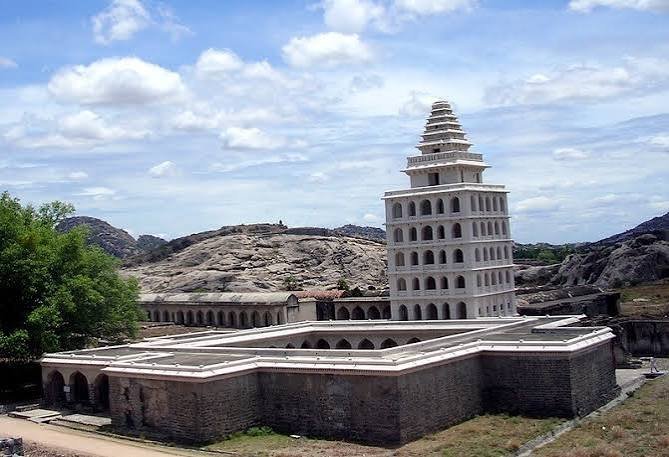
Among the most significant structures that have stood the test of time is the Kalyana Mahal. Located within the fort, this elegant, multi-storied building is traditionally believed to have served as the royal residence within the complex, starkly contrasting with the rugged granite landscape that surrounds it.
The fort compound is home to many other essential structures-the royal quarters; granaries; military barracks; temples for varied beliefs that are still visited today; temples that sit on one or two of the hills; and extensive storage systems to keep soldiers supplied.
A Natural Stronghold
The formidable nature of Gingee Fort, especially historically, can be attributed to its incredible geography. Enormous granite hills provided natural defenses against invaders that simply couldn’t be ignored, while fortifications were cleverly constructed to take fullest advantage of these extremely difficult natural positions.
Attacking armies had to overcome not just the built defenses but also treacherous, precipitous slopes. From its elevated perch, attackers, and defenders alike, could command views of movement in the far-off planes. This fusion of natural defenses with strategic military engineering made Gingee, and it’s reputation as one of South India’s strongest strongholds.
Discovering Gingee Fort
Visiting Gingee Fort can feel like traveling back to another, much simpler and yet so powerful era of Indian history. Unlike many historical sites, it requires more active participation; here you have to move around to get a fuller picture as opposed to observing it from one vantage point. The ruins of an imposing gateway still there, rocky, challenging paths for climbing, and ancient fortress walls, all together provide a real feel of the massive fortifications from long ago. Climbing is strenuous so visitors should come prepared with ample water, proper walking shoes and plenty of time to explore.
The Best Season to Visit Gingee
The weather in Tamil Nadu is more lenient during winter and so traveling and trekking feel more comfortable then. Visiting during the earliest part of morning and the late afternoon are also ideal times as this allows for cooler travel; it is not very strenuous during the mornings and late afternoon because the sun’s light is a lot gentler then, this is ideal for photography. Summers can be very hard as the sun and heat during summer can be overwhelming, so one may require more breaks. It is advised to find the operating days and times and admission fees as well as current rules before visiting the fort, and to do a little research on what may and may not be open during one’s visit due to weather or circumstances in India.
The Camera Friendliness and scenic vistas:
Photographing Gingee Fort can truly be an awe-inspiring experience due to the overwhelming granite hills combined with the fortifications of stone. Panoramic and expansive views from the peaks allow visitors an exceptional perspective on the region.
Why should you visit the Fort of Gingee?
If you have a love for history, architecture, trekking, photographing, and secluded travel spots; you should definitely consider visiting Gingee Fort. Its sheer scale and innovative design on such precipitous hills make it significantly distinct to other historical locations in India. At Find Hidden India, Gingee Fort represents the perfect emblem of exploring forgotten parts of India’s historical monuments, since while a truly imposing and historically significant structure, it remains much less photographed compared to other historical monuments. A trip to Gingee will provide you with not just wonderful photographic memories, but an education on how man and nature collaborated in ancient times to erect one of the country’s best formidable fortress.
Conclusion
Gingee Fort stands as a spectacular example of the long and rich history of South India’s architecture and warfare. Originally built over imposing granite hills and augmented throughout centuries to reflect the aims and needs of varied empires, this incredible fort continues to endure as a phenomenal place for those searching for something historic. Its giant hills, ancient walls, royal quarters and panoramic vista make Gingee an amazing location for anyone wanting something more beyond just photographs and a few simple views. Gingee Fort, in Tamil Nadu, is undoubtedly worthy of a leading position on the itinerary of any visitor in pursuit of a hidden historical gem.